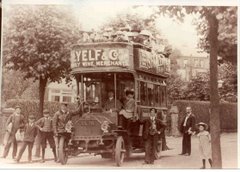
You might overlook any obvious Yelf connection in this postcard but if you click on the photo to increase the size you might be able to make out the legend 'Yelf's Hotel' on the front of the barrow being pushed up the hill. The Hotel itself would be on the left of the picture as we look at it and I would assume that the two porters are returning after having dropped luggage off at Ryde Pier in the background. There was a regular steamer between Ryde and Southampton which put Yelf's Hotel in an ideal position to capitalise on the booming holiday trade. It looks as though the pavements are covered in snow but being hand-tinted it's a little difficult to tell!
Thursday, August 23, 2007
Yelf's Hotel
You might overlook any obvious Yelf connection in this postcard but if you click on the photo to increase the size you might be able to make out the legend 'Yelf's Hotel' on the front of the barrow being pushed up the hill. The Hotel itself would be on the left of the picture as we look at it and I would assume that the two porters are returning after having dropped luggage off at Ryde Pier in the background. There was a regular steamer between Ryde and Southampton which put Yelf's Hotel in an ideal position to capitalise on the booming holiday trade. It looks as though the pavements are covered in snow but being hand-tinted it's a little difficult to tell!

Monday, August 20, 2007
Frederick Yelf and the Imperial Yeomanry

This particular piece of research was triggered by one of my periodic googlings of the name YELF. A chance search had revealed a new reference to a site that seemed to consist of names of soldiers, including one referring to Frederick Yelf. This site was owned by Kevin Asplin and seemed to focus on the IY (whatever that was…) However, of more immediate interest was the entry for ‘Yelf, Frederick 4673, Trooper 41st Coy., 12th Bn. I.Y.’
Now I have a couple of Frederick Yelfs on the file, in fact recent articles have dealt with Freddie Yelf and Frederick Steane Yelf, but I wasn’t aware of any regular army service from any of them, so at first I was rather intrigued as to what sort of dates I was looking at in this particular instance. Trooper meant he was in a cavalry regiment, but the initials IY didn’t ring any obvious bells. Looking at the rest of the site though, especially the home page and it was soon obvious that IY stood for Imperial Yeomanry, units of mounted infantry that served during the Boer War in South Africa from about 1899 to 1908. They were disbanded soon after the conclusion of that particular war so their history was a short, although fascinating one.
I was able to do some background reading on the Imperial Yeomanry on Wikipedia and other specialist sites and found out that they were initially a response to the obvious lack of mounted, mobile infantry required to campaign across the veldt of South Africa. The British government turned to the local units of Cavalry Yeomanry, a sort of 19th century Territorial or part-time local militia, as a means of raising troops quickly. These Yeomanry units had tended to attract the reasonably well-off sons of the middle-class who had undergone some basic military training and turned out for shooting competitions and parades. In the heady atmosphere of patriotic fervour large numbers volunteered for service in South Africa but their terms and conditions of service were not the same as their regular army compatriots. In the first place they only signed on for a year and in the second place they supplied both their own horse and their own uniform! No doubt they hoped that a year would be enough to see off the Boers, serve the Queen and have a bit of an adventure at the same time and they signed up in large numbers.
The different Companies of the Imperial Yeomanry were drawn from specific Yeomanry regiments. The 41st Company of the 12th Battalion Imperial Yeomanry, Frederick’s company, were drawn from the Hampshire Carabiniers (a carbine being a shortened musket for use by mounted troops) and they seem to have been based in Southampton, but who no doubt had sections over the rest of the county as well). As it turned out, the Frederick in question was Frederick Yelf, son of Richard Yelf, wine-merchant of Sandown, Isle of Wight. Frederick was born in Brading in 1878 and was 22 years and 9 months old when he signed his short–term Attestation papers in Newport on 8th January 1900. This document is preserved in the National Archive Office along with those of Frederick’s colleagues, and gives information about Frederick at the beginning and end, of his service. From the document we know that Frederick was 5’8” tall and weighed 144lbs, of fair complexion with blue eyes and brown hair and was declared fit for service by Lt. Col. Will Woods following his successful medical. The attestation documents broke Frederick’s service down into three sections; 24 days in England, 1 year 23 days in South Africa and a further 36 days back in England before his final discharge on 31-3-1901. His conduct over this period was described as ‘very good’ and his campaigns were recorded as ‘S. Africa, Senekal, Biddulphsberg’
I spent some time looking up these campaigns and found a very informative and descriptive set of accounts of the battle of Biddulphsberg as well as another showing the battlefield as it is today (complete with Boer anthem!). It is impossible to know what experiences Frederick had in the campaign but the note of his medals and clasps on the Attestation papers – namely the Queens South African medal and four clasps (the bars with names on attached to the ribbon) pinpoint exactly when and where he served. The following information is taken from the North-East Medals website where I was able to find out just what these clasps refer to. Frederick’s four clasps consisted one campaign clasp, two regional clasps and one date clasp, namely;
Wittebergen : All troops who were inside a line drawn from Harrismith to Bethlehem, thence to Senekal and Clocolan, along the Basuto border, and back to Harrismith, between lst and 29th July, 1900, both dates inclusive.
Cape Colony : All troops in Cape Colony at any time between 11th October, 1899, and 31st May, 1902, inclusive, who had not received a clasp for a specific action in the Cape Colony, or the " Natal " clasp.
Orange Free State : All troops in Orange River Colony at any time between 28th February, 1900 and 31st May, 1902, inclusive who had not received a clasp for a specific action in the Orange River Colony.
South Africa 1901 : All troops who served in South Africa between 1st January, 1901, and 31st December, 1901, both dates inclusive, who were not eligible for the King's South Africa Medal.
By all accounts the Boer’s choice of guerrilla tactics left many of the Imperial Yeomanry with only routine and boredom for much of the time and when their time was up they either applied for release or a transfer to the more exciting life of a mounted policeman. Frederick seems to have preferred to return to his life in the wine-trade and his documentation notes that he was
“Discharged at his own request from further service in connection with the War in South Africa”
Wednesday, August 8, 2007
Yelf Service Medals from the First World War
 (Picture shows the 1914 Star, British War medal and the Victory medal)
There were a number of Yelfs who served in the forces during the First World War, including a number of Canadians, one of whom was killed. These however are the service medals awarded to those serving in the British forces. The abbreviations are as recorded.
YELF Alfred Robert
Labour Corps - 2nd Lt. / Capt.
Victory Star, British War Medal and Emblems
YELF Francis William
D of Cum.L.I. - 2 Lt./Capt.
Victory Star, British War Medal France
YELF Norman
6th Lond. Rifles
Victory Star, British War Medal, 1914-1915 Star France
No. 1320320115
YELF Robert Herve
L.N.Lan.R. - 2Lt./Lieut.
Victory Star, British War Medal, 1914 Star France
YELF A.L.
6th London Rifles - C.S.Maj.
Victory Star, British War Medal, 1914-1915 Star
(also D.C.M.) France
YELF Frederick C.
Hampshire Rgt. / M. G. C. - Cpl.
Victory Star, British War Medal, 1914 Star
YELF Jack Robert
R.E./ Comm. & Staff - Lieut./Capt./Maj./Lt. Col.
Victory Star, British War Medal/1914-1915 Star
YELF Robert H.
Northn. R./ Y. and L. R. - Pte.
Victory Star, British War Medal Killed 1916
YELF Albert V.
Hampshire Regt. / M.G.C.* - Pte.
British War Medal
(*IND. GS.A?GN. NWFF. 1919 [Roll 17917-183])
YELF Geo. Henry
R.D.C. - Lieut
YELF Robert Edward Burnet
R.A.M.C. - Lieut
Victory Star, British War Medal H.S. Valdivia
Monday, August 6, 2007
The Oldest Man on the Isle of Wight - Walter Frederick ‘Freddie’ Yelf
 Freddie Yelf and family in his days as a coachman
For some of the sixties a Yelf was officially the oldest Isle of Wight inhabitant. At the grand old age of 106 Freddie Yelf had seen the reign of Queen Victoria, two World Wars and one World Cup before dying in November 1966. The following photographs are scanned from poor quality photocopies but I hope they give a flavour of the life of one of our more illustrious Yelfs, not many of whom could have been presented to the Queen!
"Mr F. Yelf of Warwick Cottage, St Lawrence, is on the right of the above
 picture. He will be 96 years old in March. With him is Mr Fred Shepherd, another nonogenarian who lives in Southampton Road, Lymington. The picture was taken over 18 months ago when Mr Yelf was in Lymington talking over old times with his former school chum. They were both educated at Lymington Congregational Church School. Mr Yelf left at the age of 12 to come to the Island, later becoming a coachman, a position he held for almost 50 years. He served the St. Lawrence ward faithfully and well on the Ventnor U.D.C. Mr Yelf is a prominent member of the local Baptist Church. The picture is reproduced by courtesy of the New Milton Advertiser and Lymington Times."
Caption to the picture on the
 right reads "The pictures of Mr Yelf of St Lawrence in this issue are by Mr Weighell and the blocks are loaned by the Evening News, Portsmouth. Mr Yelf, who was 104 last week, asked the Mercury to express his grateful thanks to all kind friends for his gifts, cards and messages of congratulation. He had 130 birthday cards, 11 telegrams and numerous presents, including money, and he particularly appreciated a letter from Alderman Woolnutt, the Island Member of Parliament, and cards from Australia and New Zealand. Mr Yelf told us "It is not so much the gift as the love and thoughts behind them".
July 1965 "The Queen had a long chat with the oldest inhabitant of the Island, 105 year old Mr Frederick Yelf"

"After 105 years his crowning day"
Ventnor Park was looking its very best for the Queen's visit to the holiday town which was crowded with sightseers and ablaze with flags and flowers. On arrival at the park, the Governor presented Mr Albert Payne, Chairman of Ventnor Council and also his daughter Mrs D. Ross. Also present were Mr Charles Davies council clerk and his wife and Mr Frederick Yelf of St. Lawrence. aged 105, the oldest inhabitant of the Island. Mr Yelf was accompanied by his daughters who are both in their eighties and he insisted on standing to meet the Queen and Prince Philip. They spoke to him for several minutes.
A TREE PLANTED
...the Queen said she was amazed at the vitality of Mr Yelf and described Ventnor as a charming place that she would like to visit again..."

"Mr Fred Yelf, 106, Dies"
The Islands Grand Old Man Mr Walter Frederick yelf of Warwick Cottages, St Lawrence died on Tuesday night at the age of 107 and seven months. He had been in very poor health for about a month.
The funeral service is tomorrow at the Baptist Church with the Rev. B. R. Pinches officiating. Former Minister the Rev. F. Glover, now at Bournemouth will also take part and internment will follow at St Lawrence.
Born at Carisbrooke and the son of a dyer for Bright & Minns, Mr Yelf went to school at Lymington when his family moved to the mainland. He was a groom for Mr Lane then Mr Langton at Gatcombe, later Mr Mew, the brewer, of Newport, earning £8 a year. His early days of drinking and smoking changed radically as he would put it "when he saw the light" and then throughout his life he assisted in various churches and brotherhoods. About 1900 he went to St Lawrence as a coachman to Mr Spindler of Old Park and later for the Rev. Brent who built Warwick Cottage for him. Mr Yelf served on the parish council 25 years and was overseer for 12 years before St Lawrence was annexed to Ventnor. He represented the village on Ventnor council and was vice-chairman, also opening the first council house to be built at Lowtherville after the war. Cottages completed at St Lawrence in 1955 are named after him. He represented St Lawrence on teh Assessment committe; was the Chairman of the Agricultural Labourers Union at Whitwell; and also in charge locally of the County Hospital contribution scheme. He spoke at many men's meetings and church gatherings; served on the Co-op Education Committee; and organized various concerts, in his younger days being a popular singer. He was also in the chopir at St Lawrence church and on two occasions painted the exterior. Mr Yelf later became a Deacon at the Baptist Church.
Up to a few months ago he had been remarkably active and last year was presented to the Queen. Mr Yelf has been devotedly cared for by two of his three daughters and his son. Mr Fred Yelf, a former postman, lives at Ryde. Mrs Yelf died in 1930."
Monday, July 30, 2007
Amor - A suitable name for a Yelf?

It’s strange how these things work. It only takes a couple of individuals to insist on doing a certain thing in a certain way and before you know it the original reasons are forgotten or lost in the mist of time and suddenly we’ve a ‘tradition’ on our hands That seems to have been the case on our particular branch of the Yelf tree with the middle name of ‘Amor’ (and that’s to rhyme with door not the French word for love!). It’s been around for a few generations now. It’s my son’s middle name and was also that of my youngest brother. The name missed my father but was the middle name of my grandfather and my great-grandfather before him. I had always wondered where it had come from and why I felt obliged to pass it down the genetic line like a hot potato, so I was intrigued when I saw a copy of Frank Amor William Yelf’s Birth Certificate of 1864. Did that elegant copperplate writing say Amor or (as it looked to me) Amos? Had generations of Yelfs named themselves after a spelling mistake? When I thought about it this didn’t really seem likely but I didn’t think to pay it much more attention until a month or two ago when I received an email from Carole Cumber in Canada.
Carole has being doing large amounts of research on the Yelf name and as it happens she is also from our ‘Amor’ branch of the family. She had obviously decided to look a little deeper and had succeeded in uncovering the origins of the Amor middle name and the results were far more interesting than a simple spelling mistake.
To summarise Carole’s findings (and it really is a summary, as Carole has much supporting documentation) we have to go to back to Salisbury in Wiltshire in the 1830’s where Francis WILLIAMS married Eliza AMOR. They eventually had seven children, Eliza, Francis, Catherine (‘Kate’), Maria, Emma, Henry and Mary. In the 1841 census they are still living in Salisbury but the 1851 census shows them living at ‘Above Bar’ in Southampton, Hampshire. But this is not the only change to the family’s circumstances obvious from the return. It seems that the pressure of having so many mouths to feed led the family to the fairly drastic step of asking Eliza’s sister, Maria AMOR, to take in the older children. Maria was a shoemaker living in Salisbury who employed a couple of workers in her business. She was single and obviously happy to take in her sister’s children as the 1851 census shows that Francis, Kate and Maria are all living with her whilst still attending the local Salisbury school. Presumably on completion of their education the children returned to their parents in Southampton.
The WILLIAMS family were not the only ones living at ‘Above Bar’ at this time – the YELF family were also living in the same area of Southampton and, as these things go, Catherine (Kate) WILLIAMS married her near neighbour Robert YELF. In 1864 they had a son called Frank Amor William YELF who might now possibly be seen to have been named for the following reasons - Frank (Possibly a version of Francis?) Amor (after the aunt who had been so important to Catherine?) William (a traditional Yelf name, but also near enough Catherine’s maiden name) Yelf (father’s name). Of those it is interesting that it is the Amor that has come down to the present day and become a family tradition, presumably because of its unusualness. None of us had an inkling that it was all due to the kindness of a maiden aunt who made shoes for a living but for what its worth my twelve year old Amor-named son seemed quite pleased with the result of all Carole’s hard work!
Thursday, July 26, 2007
“Reader, I married him..” – Yelfs in fiction
Let’s be honest here, this is not the sort of article you would expect to see written on a site dedicated to anyone researching the Browns, Bakers or Bartholomew family. Any attempt to look at the range of any of these names in fiction would be futile because, … well, there are just too many! If this is the case with these common names then the opposite is true with Yelf though. A name given to a few hundred individuals in a small corner England would be extremely unlikely to crop up in a work of fiction and you’d think that the chances of anyone deliberately choosing it were nigh on zero and if by some strange coincidence they did use it, you’d have to wonder where they heard it originally. Still, I thought it was worth a look so off I went…
First up is “The Story of Dick” written by Ernest Gambier Perry. This seems (and I have to confess I haven’t read it) to be a typical uplifting Victorian story of an orphan or poor relative moving in with a new family. There’s tension action and adventure and at last the youngster is seen to have been a positive force for all those around him. But don’t take my word for it as I found a short extract from “The Review of Reviews” by by William Thomas Stead in 1936Without exactly intending to be unkind, Mrs. Yelf—a somewhat milder edition of Hannah Grieve – resented the coming of her brother-in-law’s ten year old soldier-like child to her home fearing that he would influence her own little son, whom she coddled and spoiled. In some respects the story reminds me of “Tim” but it is far happier and quite as pathetic. .Dick himself is a fine, honest, manly little chap and he soon strengthens the farmers girlish boy. The scene in which he reads the burial service over the soldier-suicide’s grave is very pretty. This is a story that will delight children and “grown-ups” alike.
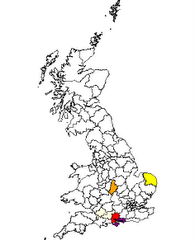
Ernest Gambier Perry seems to have come from a wealthy and artistic family. His father, Thomas Gambier Perry was a notable art collector of Renaissance works whose collection now forms part of that belonging to the Courtauld Institute in London. In 1915 Ernest inherited much of his fathers collections in 1915, along with the Highnam Court Estate. Ernest also wrote articles, notably one on sport and sportsmen for the ‘New Review’ in1894 but I have not, as yet, found any evidence of other books. So where did he come up with the name of Yelf for the family? Well a look at the map shows that the Highnam Court Estate is just by Gloucester and about 45 minutes from another Gloucestershire town, Moreton-in-the-Marsh and in 1891 this was the home of one of the few Yelf families outside of Hampshire. (see the 1891 Yelf distribution map to the right). My guess would be that Ernest had either heard of or read of the Yelfs or possibly, as they were doctors and surgeons, met them in a professional capacity. He was looking for an interesting and unusual name for his protagonist family and Yelf fitted the bill nicely. OK, there’s no proof and this is wild speculation on my part, but it is a possibility. The only direct quote I could find for this book was
‘Mrs. Yelf prided herself upon the training of farm-servants’
which is always a useful skill to be able to fall back on!

I am again having to scratch around for on-line references, but the quotes I did find give a general indication of the Yelf’s progress through the novelsSeth Warren was indeed called second mate by which was merely meant that he took charge of the Captain’s watch whenever he saw fit to go below for Captain Rhines stood his own watch. In the larboard watch were Robert Yelf and Sam Edwards
“The sponge they obtained by diving ; and Yelf brought up one that had attached itself to a conch” The Ark of Elm Island
“Father knows all about vessels, and Mr. Yelf is a regular shipwright. ... Ben and Yelf made the same criticism as Uncle Isaac” Young Shipbuilders of Elm Island
“…Yelf could ride when altogether too drunk to walk” Lion Ben of Elm Island
“…old Mrs. Yelf, was staying with me (she was a Dinsmore before she
married Sam Yelf)” Boy Farmers of Elm Island“Yes ; tell us," said Charlie. “Well, I'll tell you, and see what you think of it.
Mr. Yelf is going to be put into the ground to-morrow, ...” Charlie Bell the Waif of Elm Island
Tuesday, July 24, 2007
Frederick Steane Yelf, his house, another Yelf and a Hundred year gap!
 The Yelfs are a very small, select family. In the 1890’s there probably were not more than two hundred Yelfs in the world. Now, there are probably about eighty to a hundred. When you think that historically the vast majority of those Yelfs were to be found on the Isle of Wight you would think that the chances of associating two Yelfs with a single house, outside the Isle of Wight, over the span of a hundred years must be pretty remote. Or put it this way – pick any house in England and ask yourself what the chances are that a Yelf might have crossed its threshold – then try to calculate the odds that two Yelfs have crossed the threshold, but separated by almost 100 years. Well as it happens I stumbled over one of these rare beasts not a week ago.
Frederick was born in 1831 on the Isle of Wight. His parents were Robert and Sarah Yelf and the 1841 census return for shows Frederick and his brother Leonard attending the Play Street Academy under the tuition of Mr Browne. Leonard Keatley Yelf went on to become a notable GP living in Moreton–in-the-Marsh in Gloucester but Frederick seems to have opted for a career in the Civil Service. The War Office List of 1863 records Frederick as being a 3rd class clerk in the ‘Director of Works’ branch responsible for Barrack and Hospital Repairs and Construction. To quote part of his entry,
“YELF F. Clerk 3rd class, War office. Appointed a temporary clerk in the late Ordnance Office, Jan 1856 and promoted to the Establishment of the Consolidated War office in 1856”
By 1883 both Frederick and his brother both appear as executors on his fathers will and at this time he is living in Hammersmith. In the same year his War Office returns reads
“YELF FREDERICK S. Late junior Clerk, War Office. Appointed a temporary clerk in the late Ordnance Office, Jan1856 and promoted to the establishment of the Consolidated War Office, April 1856. Retired, on-reorganization, March 1880 on a pension of £226 13/4d a year with gratuity”
My first mention of Frederick at Wimbledon is in about 1887 when he seems to have moved into his new house in 34, Queens Road Wimbledon, a road of three story villas laying alongside the railway track and only three or four minutes from the station. Frederick’s wife Ellen seems to have died by about 1880 so for the whole of the twenty odd years he was living in Wimbledon it was with his daughter Florence Steane Yelf. By 1907 he has evidently de-camped to Hove in Sussex for the latter part of his retirement where he died in 1911, followed by his faithful daughter Florence in 1935.
Unearthing all this information was enough to persuade me to hop on my bike one lunchtime in order to see if the house was still there. In truth I was half expecting to find that the site was now a retail development but I was pleasantly surprised to find that the building itself was still there. Not unchanged though, as in it’s original state it had been a semi-detached building like the rest of the road around it, but both 32 and 34 Queens Road had been purchased and combined into a single building which, with suitable extensions, was now an exclusive retirement home! The pictures show the building as it now is - Fredericks house was originally the right hand side of the building with the single porch being the site of two front doors. All the neighbouring houses retain their original layout so it was easy to compare and to imagine the original layout.
Subscribe to:
Posts (Atom)