Any further commentary on my part would be wasted, so get yourself a nice cup of tea, a pencil and a calculator and settle down for some real-life detective work!
Showing posts with label William Wheeler Yelf. Show all posts
Sunday, October 4, 2009
William Wheeler Yelf - The Parliamentary Papers of a Convicted Defalcator
Any further commentary on my part would be wasted, so get yourself a nice cup of tea, a pencil and a calculator and settle down for some real-life detective work!
Monday, March 17, 2008
William Wheeler Yelf - Supplemental
It's strange how these things go.... a few weeks ago I had just finished my last little piece on William Wheeler Yelf and was thinking of the next Yelf item to post about when something popped up on ebay. It was a copy of the Illustrated London News dated Saturday April 23rd 1853 an although its lead story was Mr Gladstone's budget (an increase in the duty on Scotch and Irish whiskies was in the offing), what caught my eye was a story from the provinces entitled Defalcations at a Savings Bank, Newport. It was, of course about poor old William Wheeler Yelf whose crimes had hit the big time of the London weeklies!It took a while but following a frantic bid I obtained the newspaper for a total of £14.99 and I was happy to find that it had arrived today. It was quite strange to think that I was reading a paper produced at the same time as William Yelf's trial - a real piece of Yelf history and an incredible co-incidence that it should appear for sale when it did. Anyway, the piece itself is scanned in below but for those that can't be bothered clicking on the picture for a closer look I have transcribed the full text.
DEFALCATIONS AT A SAVINGS BANK, NEWPORT - On Tuesday week an inquiry was instituted respecting the deficiencies at the savings-bank. It appears that the accounts at the bank had been kept in the most careless manner and that the accused (Yelf) who is the actuary, must have commenced his dishonest practices as early as 1839. It was then that he first presented a false cheque for £150 and since that period many such-like memoranda have been used by him. Large sums of money must have been extracted from the deposits by Yelf as there is a deficiency existing of £8276 16s 3d. On Monday he made a full confession of his guilt, and has expressed a desire to render every assistance in making the necessary inquiries. One great source of regret is, that, from the great loss of which stock of not more than £60,000 has experienced, a reduction of nearly 25 per cent will take place in the value of each person's investment.
Thursday, February 7, 2008
William Wheeler Yelf - One Man's Downfall Part 3

Convicted of fraud, sentenced to transportation and lucky to escape execution - William Wheeler Yelf must have felt himself at the lowest possible ebb as he was removed from his family and taken up to London to await transportation. What is interesting is that his printing business seems to have carried on unaffected. Certainly there is no mention of a crisis in 'Printers Pride' and as was seen, the business eventually passed smoothly on to Richard Yelf. Had the Bank recouped all it's losses? Did they take pity on the innocent members of the family? We don't know, but for William, with his health failing, being placed in prison must have been the last straw. Millbank prison, on the bank of the Thames, was the point of embarkation for those sentenced to transportation. Charles Dickens noted in his Dickens's Dictionary of London, 1879
Millbank Prison stands on the river bank, near Vauxhall-bridge. It is built on Benthams “Panopticon” plan, six different buildings radiating from a common centre. The building is intended to hold 1,000 prisoners, and cost half-a-million, which, with ground rent, &c., represents an outlay per head for rent, &c, of about £50 per annum, or, as the prison is rarely more than half full, practically not far short of £100. Prisoners pass through here from Newgate and elsewhere as the first stage of “penal servitude,” and the discipline is somewhat severe. Orders to view from Home Secretary, or Directors of Convict Prisons, 44 Parliament-street, S.W. NEAREST Railway Station, Vauxhall; Omnibus Routes, Vauxhall-bridge-road and Palace-road ; Cab Rank, Vauxhall-bridge.The site of the prison is now covered by the Tate Gallery, but the small steps, especially designed for prisoners in leg-irons, are still visible leading down to the river bank. Incarceration in such dismal surroundings must have taken its toll and sickness eventually overcame William. Before he could be transported he died in Prison on 9th March 1854, nine months after he was convicted. His death certificate states that he died of bronchitis and disease of the heart. I've no idea where he was buried, but it seems the family were able to 'gloss over' this unfortunate episode and the overstamping of William Richards initials on his father's might have been a strong symbolic act. News of his final demise was noted in a curt report in the 'Bankers Magazine and Journal of the Money Market' of 1854.
ISLE OF WIGHT SAVINGS BANK - Yelf, the fraudulent Isle of Wight actuary, died at the Millbank Penitentiary in the early part of March
William Wheeler Yelf - One Man's Downfall Part 2
For many years it seems William Wheeler Yelf and his business prospered. He was a respected member of Newport society and a leading light in the Methodist church as well as holding a number of other prestigious posts, including the secretaryship of the local Building Society. But it seems that the Building Society had an uneasy suspicion that something wasn't right. It might have been a strange entry in the ledger, or an unusually large number of transactions, whatever it was they knew that something wasn't right. In George Robb's book 'White Collar Crime in Modern England' he notes that The trustees ... allowed Yelf, a Wesleyan preacher, to inspect the books, which he invariably found sound.It's not clear what transpired, but the bank were obviously not convinced and took further action. The Isle of Wight Observer of 23rd April 1853 carried an item that would no doubt have caused gossip amongst the middle class of Newport
BOROUGH SESSIONS - William Wheeler Yelf, printer, bookbinder, secretary to the Isle of Wight Savings Bank and stamp distributor, was charged with fraud and embezzlement. J. Eldridge Esq., one of the directors of the Savings Bank, prosecuted and J.H. Hearn Esq. defended.This was a not-so-small fortune in the 1840's and William was remanded in custody. His case was deliberated for over 5 hours before the decision was made and he was sent for full trial at the Winchester Assizes. The next report in the Observer was in the edition of 16th July 1853
The prisoner filled a respectable position in society - the Directors had placed implicit confidence in him - he had made gross alterations to the balance sheet from 1838 to 1849.
A letter from W. W. Yelf to Mr George Kirkpatrick, trustee of the savings bank, dated 16th April 1853, was read out "...he had to reveal the secret that was destroying his health...In a moment of sudden and great pecuniary embarrassment led to the downward path of ruin...sincerely repented...have told my wife and son...my son and mother in law, Mrs Outridge, have a bedroom, which I hope will be secured to them...the rest I freely yield up..."
£8, 276 16s 3d was the discrepancy in the balance sheet...he had placed a false cheque of £150 before the Trustees in 1839 [list of amounts taken]. Totalled £4,182 - it was supposed the rest was compound interest
The prisoner was remanded.
HANTS SUMMER ASSIZES - William Wheeler Yelf, charged with committing fraud and embezzling the Isle of Wight Savings Bank of £4,182 over ten years, but the books show a discrepancy of £8,200It looked as though a new life was beckoning William in Australia. Part three will look at what happened next...
Yelf pleaded guilty.
Mr Sewell made an eloquent appeal for mitigating of punishment - the prisoner had given himself up etc.
Mr Baron Marten said he would be departing from his duty if he didn't inflict the most severe punishment - a few years ago he would have been executed.
Sentence - Transportation for Life
Monday, December 17, 2007
William Wheeler Yelf - One Man's Downfall - Part 1

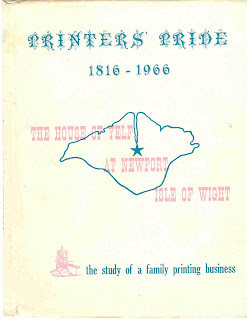
Anyone interested in researching the Yelf family history will at some point or another hope to obtain a copy of "Printers Pride 1816 - 1966" by A.N. Daish. This tells the story of Yelf & Son Printers at Newport, Isle of Wight. It's a good read too, although some of the early family history is a little bit suspect (the author confuses several Robert Yelf's, which is easily done, and also latches on to some incorrect family legends such as the Dutch connection). Of course the sections we can treat with a great deal more respect are those dealing directly with the dynasty of printers themselves. Except, it seems, where there might be a whiff of scandal in the air...
When I first read the book many years ago the following passage concerning the second and third generation of Yelf owners had nothing in it to suggest that anything out of the ordinary
The business plate of William Wheeler Yelf, son of the first William, remains in place today on the front door of Number 15 Holyrood Street. The second W is overstamped with an R recording the succession of William Richard to the business in 1856 on the death of his father. Although William Richard may not have been able to afford a completely new business plate (or was he possessed of a keener sense of historical values?) he appears to have prospered since by the 1880's he was using the imprint Isle of Wight Steam Printing WorksPretty innocuous really, and not much to raise the suspicion of anything wrong. However the succession from William to Richard took place following William Wheeler's death in a London prison whilst awaiting deportation! The 'keener sense of historical values' takes on a slightly different connotation in this light and suggets to me that the author might well have had some inkling of the traumatic events that rocked the business at this time, although it is now impossible to know for sure. Certainly writing in the '60's he would probably not have had such easy access to the records that we of the internet age enjoy so let's give him the benefit of the doubt.
So who exactly was William Wheeler Yelf? Well, he was born in about 1801, the son of William Yelf who founded the printing business in Newport, Isle of Wight. He married Elizabeth Jane Outridge and they in turn had six children - William, Harold, Elizabeth, Agnes, Gertrude and Clara. Although his main business lay with the printing, he had other interests, as a look through the trade directories of the time shows
Piggots Directory 1831 - Newport Isle of WightThe Yelfs were also staunch followers of the Wesleyan movement and the first William Yelf founded the Wesleyan Methodist Sunday School in 1810. In 1816 William Wheeler Yelf became a teacher there and eventually became a superintendent between 1826 to 1839. Not surprisingly he also seems to have attracted more than his fair share of religious printing jobs! William Wheeler was also secretary of the Blue School, a girl's charity school in Newport, subscriber to the relief of the poor and prominent in the list of charitable donations. All in all he seems to have been a respected, religious and successful businessman. In fact as Daish notes
Savings Bank - Guidhall (open every Monday morning from nine till ten) Wm Yelf, Secretary
Bookbinders - Yelf William W. Holyrood St.
Fire & Office Agent - London Union William W. Yelf Holyrood Street
Printer - William W. Yelf Holyrood Street
Misc. - Willington & Yelf Law Stationers and Stamp distributors, Holyrood Street
It may be suggested from his prompt payments that W. W. Yelf had a sound business awarenessSadly that image wasn't to remain untarnished for long as his 'business awareness' was found not only to be sound, but unscrupulous as well!
To be continued
Subscribe to:
Posts (Atom)